
The Spaces In Between
Learning what to leave out.

Note, this essay is directly inspired by, and takes a couple of sentences from, an exchange with Paul Fishman, a superb writer who I am fortunate enough to call a friend. You can read his writings here.
Many of my essays are inspired by friends, and even when the link isn’t direct, there will usually be a person I hold in my mind when I am writing. I imagine I am speaking to them, and then I write down the words.
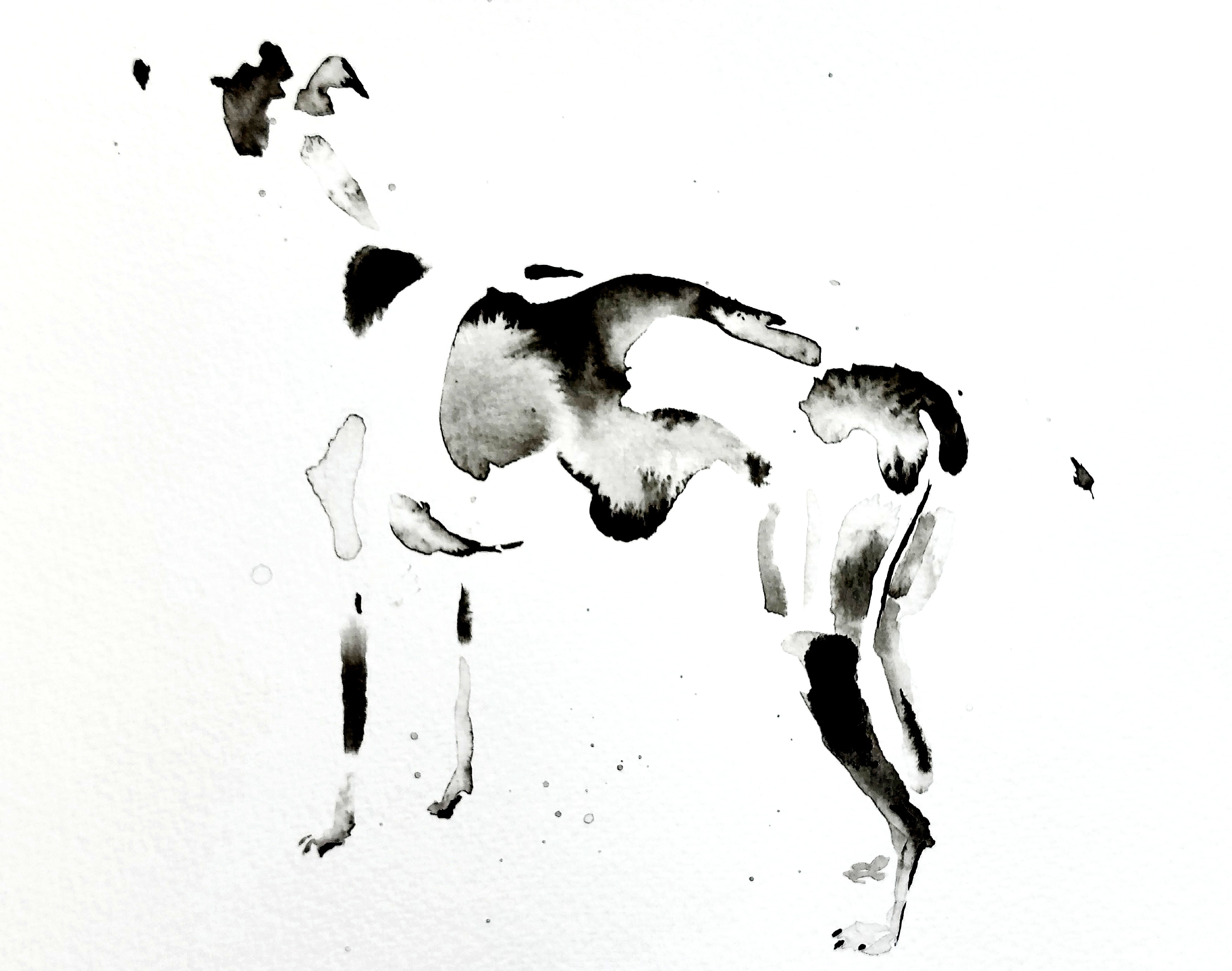
One of the things that is hardest, but most important, to teach when teaching art is the importance of leaving stuff out.
I’ve become an art teacher quite accidentally, or a mixture of accident and financial need. It is easier to sell the experience of an art workshop than it is to sell an oil painting. Once I started teaching, terrified and fumbling, I surprised myself to find I was good at it, or at least, people kept coming back, or inviting me back, or otherwise asking for more.
I teach a range of different ways of making art, and none in very much depth: I view it as my role to introduce folks to a multitude of ways of expressing their creativity, so they can see what resonates with them. Which rabbit holes they would like to go down. I show them the entrance to wonderland, but it is them who has to walk through.
Being an art teacher of my own design has fostered opportunities for observing human beings that I never had before. When someone picks up a paintbrush, they may as well be a novice poker player, stepping to the card table. They are full of tells that say everything about how they think about themselves, their art, their place in the world.
One of the simplest and most obvious is how they hold a pencil. Some folks hold a pencil in wildly unergonomic and uncomfortable ways, gripping it with fingers curled in a tight embrace that belies a deep fear of… I can’t know for certain, but I suspect a fear of getting things wrong, a fear that I will think them inadequate, and they will be disappointed with what they create. Their arm muscles ache by the end of a lesson, their shoulders up around their ears. I encourage these folks towards materials and exercises that cannot be performed through control, that need large, sweeping movements, play, and experimentation, hopeful that as their body makes the link between creativity and curiosity and relaxation, their shoulders will come down, their forearm muscles will untighten, and they will find themselves able to do the drawings they want. Other folks grip the pencil right at the nib, restricting themselves to only the smallest of movements and marks. There is a fear here, too, a fear of taking up too much space, perhaps, of making a mess. I will gently coax them into holding the pencil as far from the nib as possible, or even tape the pencil to the handle of a long paintbrush, hoping that in creating the distance between their hand and the paper, they will start to find joy in the marks that are imperfect, but truthful.
The worries that burden a person when they step into an art class affect their grip, which in turn affects the marks they make, which in turn affects the art they produce and the way they feel about themself. If you observe closely, you can witness folks getting into an immediate negative spiral: it is my job, as an art teacher, not to tell people how to draw, but simply to interrupt this process, and set them on a different path.
A worry that I must interrupt, and usually do around lesson two or three, is the fear of not being fully understood. Art is a form of communication, a record of observation, thought and feelings that can persist over continents and centuries (if adequately preserved) and most people connect with this desire to communicate, even if they don’t consciously linger on it. When people begin make marks on a page, they want the people who see those marks to understand them. They want their audience to know that what they saw was a cat, or a tree, or a vase of flowers. As a consequence, the marks they make over explain the simple facts, and leave out the subtle details, the observations that are unique to them and change a drawing into an artwork.
What I teach is to trust your audience, and to give them a bit of the puzzle to figure out for themselves. From my past career in academia, the prevailing theory of How The Brain Works, or at least, the theory that my colleagues and I in the developmental neuroscience subfield were discussing four years ago, was that the brain is essentially a prediction machine. It encounters a stimulus, encodes a pattern of activity across cells, uses that pattern to predict future stimuli, and adapts the pattern when the predictions are incorrect. Our brains want to predict, test, and learn, they are hungry for it. There is a satisfaction that comes from viewing a painting and allowing the understanding to creep up through you slowly as your predictions are proved correct or false.
[Side note – this is part of the reason why the easiest way to make a lab rat – or a human being – feel like they are going crazy is to give rewards that they can’t predict. A rat that knows a treat is dispensed when a lever is pressed will be able to live happily. A rat that receives treats with no pattern spends all its time obsessively waiting for treats. Consider, now, how human beings react to gambling, volatile financial markets, trains that keep being delayed in two minute increments, or social media notifications that are purposefully delayed by algorithms…]
When we make marks to communicate, the skill that turns those marks into an artwork are the things we choose to leave out. The parts of the painting that we hand over to the viewer, and invite them to complete.
Of course, every writer knows that you don’t tell the twist on the first page, every director of thrillers and horror films knows that the jig is up when the monster is revealed; the shark is much more frightening when it is two notes on a cello and some dark water, not a ridiculous robot seen in clear daylight. Every romantic story holds the reader’s attention through the slow burn of misunderstandings and missed opportunities that the reader gets to partake in.
With painting and drawing, we can choose to leave part of the puzzle to be solved. A shadow that implies a hand. Colours that aren’t photographically correct, but communicate tone and emotion through their conscious choice. A composition that leaves a complex interpersonal dynamic to be figured out.
When we fail to leave anything to the imagination, we deny our viewers the opportunity to commune with us, to enjoy being told a story of who we were and what we saw that invites them to join in, to process and interpret. The craft is in the pauses and silences, the things that we notice to be significant through a lifetime of experience. In our current age of technology, where so many have been quick to produce facsimiles of art, I hope that the value of this conversation, this skilful storytelling, will be brought to the surface. We will understand and appreciate that the point was never a product to be sold, but a way for human beings to continue a sacred and silent conversation, across millennia.